The Long View of Atopic Dermatitis Control
In treating atopic dermatitis, the question is not only how quickly a patient can improve, but how to build a plan that respects the chronic, relapsing nature of the disease itself.
May 06, 2026
Atopic dermatitis (AD) has always asked clinicians to think in two timelines at once. There is the timeline of the patient in front of you, uncomfortable now, sleeping poorly and wanting relief. And then there is the timeline of the disease itself: chronic, inflammatory, relapsing, and not especially interested in the tidy endpoints by which therapies are often measured.
In a recent Topical Conversations discussion, Dawn Merritt, DO, and Naiem Issa, MD, PhD, came back to that duality again and again—the difference between getting a patient better quickly and choosing a treatment strategy that can really last.
“We live in the digital and very fast-paced age of Amazon Prime, where we want things to happen now, or even yesterday,” says Dr Issa. In clinical trials, short-term data are necessary because they establish whether a therapy meets a regulatory benchmark and can move forward. But in clinic, “You have the reality of the long-term course of the disease.”
For patients with AD, it can be hard to reckon expectations with biology. Many have known the immediate relief of systemic steroids and also know the return of symptoms when that relief doesn’t last.
“Sometimes it takes handholding from us,” says Dr Merritt, especially with patients who are unhappy that they are not exactly where they want to be within a week or two. “We’re looking for something that’s safe and effective that they can stay on for the long haul because this is a chronic disease,” she says. “We can’t cure it. We can just manage it.”
Systemic therapy for atopic dermatitis is not meant to flatten the immune system indiscriminately. The goal is to use targeted options that help reregulate the inflammatory pathways driving disease. Understanding the distinction may also help patients understand why persistence matters for response.
“We’re not putting an atomic bomb to these patients for their immune system. There is an investment on their part,” says Dr Issa. “Sometimes you need to wait it out.”
Choosing With Chronicity in Mind
That investment becomes especially relevant as clinicians think about therapy selection beyond the first few months. For Dr Issa, interleukin 13 (IL-13) has become a central part of the discussion. IL-4 remains important in AD, but “we’re learning much more that IL-13 is truly a key player in AD,” he says. Affected skin shows higher IL-13 gene expression than unaffected or normal skin, and IL-13 levels appear to rise with greater disease severity.
When it comes to the practical implications of targeting IL-13 directly, Dr Issa considers tralokinumab, including in patients for whom clinicians are weighing certain adverse-event considerations seen with other systemic options, like arthralgias.
“One of the things you’re trying to avoid is this chronic switching,” says Dr Merritt. “Your approach would be to maybe try and choose something in the beginning that you can sustain.”
“We’re looking for treatment paradigms that could reduce risks and also optimize results all in one swoop,” adds Dr Issa. In other words, the decision at the start of treatment should already be thinking several steps ahead.
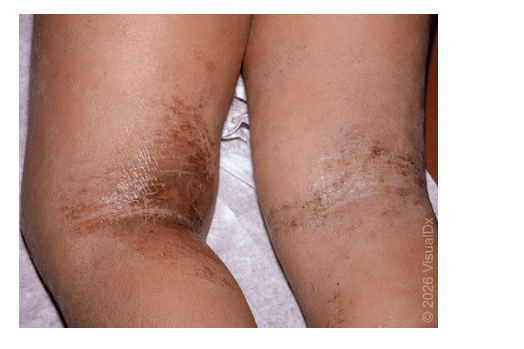
Atopic dermatitis in the backs of the knees, a common flexural site, showing chronic eczematous change with thickening, discoloration, and excoriation from ongoing inflammation and itch.
Image source: VisualDx (visualdx.com)
When Control Becomes the Strategy
Injections may be acceptable, even routine, for many patients, but less frequent dosing always matters. Adult patients [weighing less than 100 kg] who achieve clear or almost clear skin after 16 weeks, the possibility of moving to monthly dosing can be quite meaningful.
“I don’t know anyone who’s upset about doing fewer shots,” says Dr Merritt.
That point seems almost obvious, but a therapy that works is one thing, and therapy patients can imagine continuing is another. “They ask, ‘Hey, doc, is this a forever drug? Give me some numbers on this,’” says Dr Issa.
The answer, as in most chronic inflammatory disease, is not absolute. Some patients who responded after 16 weeks were able to maintain response with less frequent dosing, and some maintained clear or almost clear skin or EASI-75 response after withdrawal through the rest of the year. “Imagine you have a one out of four chance of not having the disease come back when you got off of drug,” he says. “Would you take those odds?”
“I think all of my patients would take those odds,” says Dr Merritt.
Patients with AD are weighing efficacy curves alongside time, discomfort, fear of relapse, injection burden, prior disappointment, and the hope that something might finally remain steady. “You have to be in it to win it,” Dr Issa adds.
For clinicians, that may be the harder discipline of modern atopic dermatitis care. Choosing with chronicity in mind, counseling with patience, and helping patients understand that control is a strategy itself.
References:
Wollenberg A, Blauvelt A, Guttman-Yassky E, et al. Tralokinumab for moderate-to-severe atopic dermatitis: results from two 52-week, randomized, double-blind, multicentre, placebo-controlled phase III trials — ECZTRA 1 and ECZTRA 2. Br J Dermatol. 2021;184(3):437-449. doi:10.1111/bjd.19574
Blauvelt A, Langley RG, Lacour JP, et al. Long-term 2-year safety and efficacy of tralokinumab in adults with moderate-to-severe atopic dermatitis: interim analysis of the ECZTEND open-label extension trial. J Am Acad Dermatol. 2022;87(4):815-824. doi:10.1016/j.jaad.2022.07.019
Greenberg ABW, Shahriari M, Cameron M, et al. Tralokinumab as a therapeutic alternative for dupilumab-associated arthralgia in atopic dermatitis: a multi-center case series. J Clin Aesthet Dermatol. 2025;18(5):16-19.