Culturally Sensitive Hair Loss Examination: A Framework for Advanced Practice Dermatology Providers
Culturally sensitive approaches to alopecia evaluation — This article highlights how clinicians can integrate cultural awareness, hair morphology knowledge, and respectful examination techniques to improve diagnostic accuracy and patient outcomes in hair loss care.
By KimberlyG. Baker, NP | June 09, 2026
Hair loss is a common chief complaint in dermatology and often carries a significant psychosocial burden. Early and accurate diagnosis is essential to optimize outcomes, particularly for scarring alopecias where delay may result in irreversible hair loss. A culturally sensitive approach to hair loss evaluation strengthens the therapeutic alliance, improves diagnostic accuracy, and supports equitable dermatologic care. This article highlights culturally sensitive approaches to evaluating patients with alopecia.
Hair loss frequently affects self-esteem, identity, and quality of life. Patients may experience depression related to perceived changes in appearance or anxiety about the permanence of hair loss. Concerns may be amplified in patients who feel that their symptoms were previously minimized or inadequately addressed. A culturally informed hair loss evaluation begins with sensitivity to the cultural importance of hairstyles and traditions and an acknowledgment of the emotional impact to help validate the patient’s experience.
Patients may invest considerable time and money into hairstyles that reflect identity, religious practice, personal expression, and practicality. Styles and practices such as braids, weaves, wigs, chemical straightening and hair coverings such as turbans or hijabs and not merely cosmetic choices; they may serve protective, functional, religious, or cultural roles. Evaluation of hair practices should start with open-ended, nonjudgmental questions such as, “Can you describe your usual hair routine?” Clinicians should be familiar with common terminology such as relaxers, silk presses, sew-ins, protective styles, and edge styling to increase credibility and facilitate rapport.
Understanding hair morphology is critical for accurate assessment. Hair structure varies among individuals and across populations: tightly coiled hair (often type 4) tends to have an elliptical cross-section and increased curvature, predisposing it to fragility and breakage at points of twist. In contrast, straight or wavy hair tends to have a round or oval shape with different patterns of fragility or shedding. These variations, along with styling practices and washing frequency, can impact clinical findings and interpretation of exam techniques such as the hair-pull test.
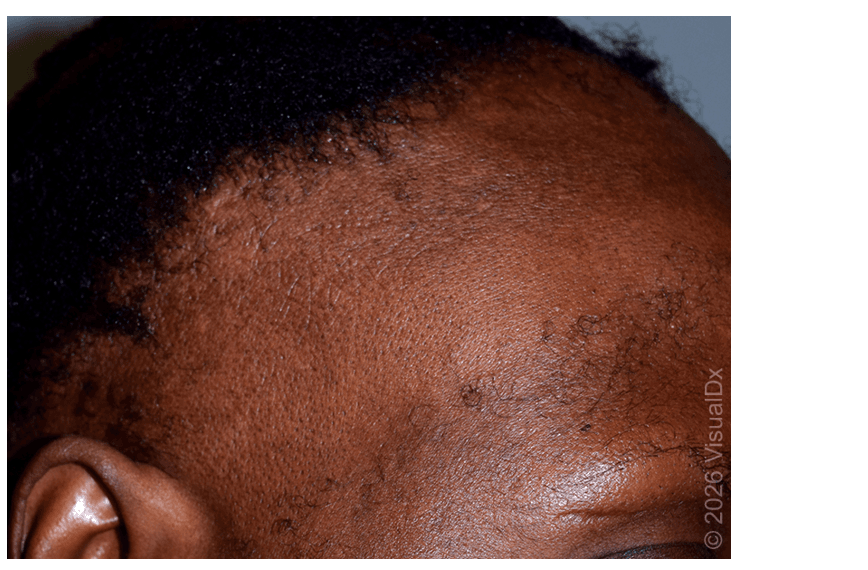
Frontal fibrosing alopecia along the frontal hairline, showing progressive recession of the hairline with perifollicular discoloration and loss of follicular openings, characteristic of chronic inflammatory scarring hair loss.
Image source: VisualDx (visualdx.com)
Clinicians must also be mindful of diagnostic bias in hair loss evaluation. Conditions such as traction alopecia (TA), CCCA, androgenetic alopecia, lichen planopilaris, and alopecia areata may present differently depending on hair type and styling practices. Although TA is commonly associated with high-tension hairstyles and CCCA is more prevalent in women of African descent, neither condition should be attributed solely to grooming practices. For example, TA can occur in any racial or ethnic group and may be associated with chronically tight hairstyles or tightly secured head coverings. Tight ponytails, regardless of any ethnicity, may contribute to frontal traction alopecia. CCCA has a multifactorial etiology, including genetic susceptibility, and should not be presumed to be due to hair care practices.
A respectful and systematic hair examination is essential. As noted in the accompanying video, providers should first request permission and explain each step of the exam. Many patients have invested considerable effort into their hairstyles, and unnecessary disruption should be avoided. Hair should be parted gently and examined in sections to minimize traction and preserve style integrity when possible.
Counseling should emphasize harm reduction rather than elimination of culturally significant hairstyles. Patients may not be aware of the spectrum of less damaging styling alternatives (see Table 1) and may benefit from education in this regard, along with a discussion to consider reduced duration of tight styles, increased use of protective modifications, reduced use of hardening gels or sprays and careful spacing of chemical treatments. Collaboration is essential to developing realistic treatment plans that align with cultural practices, hair texture, and hair care routines.
A culturally sensitive hair loss examination integrates clinical expertise with respect for identity and lived experience. By combining a thorough assessment with an awareness of cultural hair practices and psychosocial impact of hair loss, advance practice providers can foster trust, support equitable care, and improve outcomes in patients with alopecia.