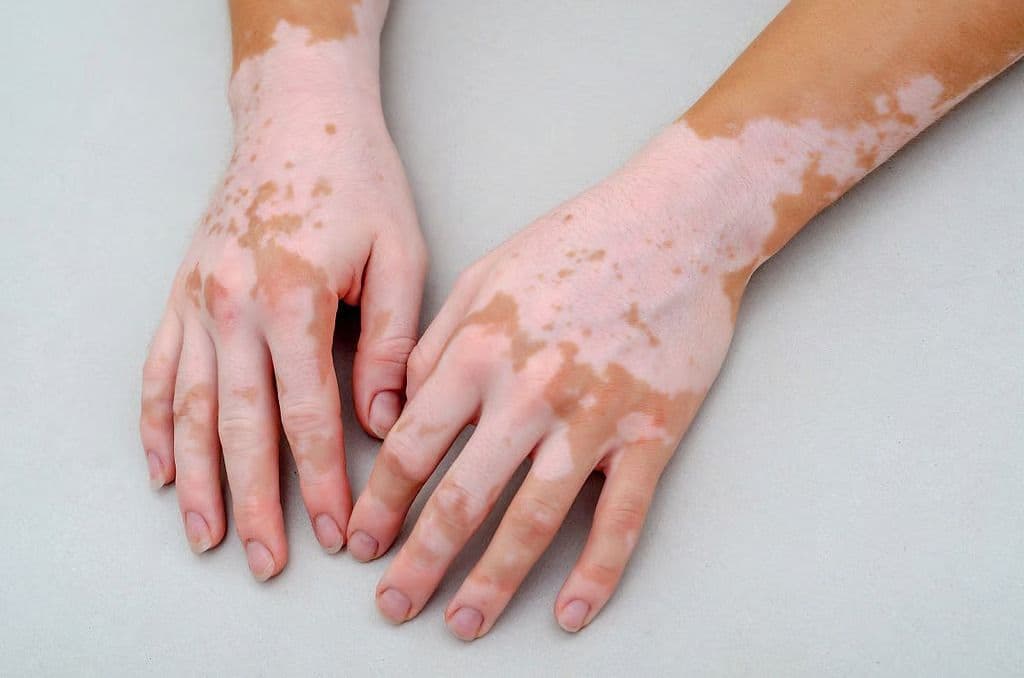
What Light Still Asks of Vitiligo Care
As vitiligo treatment options expand, narrowband UVB remains an important part of care, with success shaped by patient selection, variable response, and the challenges of sustaining treatment over time.
By Dermsquared Editorial Team | November 09, 2026
Of all the treatments a clinician can offer a patient with vitiligo, narrowband UVB may be the one whose results are hardest to see coming. For weeks, sometimes months, a patient arrives two or three times a week, spends a few minutes under the lamps, and leaves with skin that looks much as it did. Then, if things go well, small islands of pigment appear around the hair follicles, and the patch begins, very slowly, to fill in.
That gap between effort and evidence has always been part of phototherapy. What has changed is the company it keeps. With topical ruxolitinib now approved for nonsegmental vitiligo, alongside corticosteroids and calcineurin inhibitors, the more pressing question is when light belongs in a regimen, and with what.
Part of the answer lies in a distinction that is easy to blur. Stabilizing vitiligo and repigmenting it are related goals, and one does not guarantee the other. A patient whose disease has stopped spreading may see little pigment return; a patient who repigments well may develop new patches a year later. NB-UVB is unusual in working on both fronts, dampening the autoimmune response while stimulating melanocytes to proliferate and produce pigment.
That dual action helps explain why it remains a recommended option for extensive disease and for patients who have not responded adequately to topical therapy.¹ For more limited involvement, the 308-nm excimer laser or lamp concentrates the light where it is needed and spares the surrounding skin.
Ruxolitinib has made combination therapy an easier conversation to start, and a more complicated one to finish. Its label limits application to 10% of body surface area, so the patients for whom whole-body NB-UVB makes the most sense often have more disease than the cream is meant to cover. Within that limit, evidence for adding light to the cream is beginning to accumulate.
In an exploratory phase 2 study, patients with less than 25% improvement in total VASI after 12 weeks of ruxolitinib cream had NB-UVB added and went on to achieve further repigmentation.² The signal is real but modest. The study was small, and its design makes it difficult to separate the contribution of the light from that of more time on the cream. Whether the two should be started together or in sequence remains an open question. Reading the response takes patience and some attention to anatomy. The face and neck tend to respond earliest and most completely, followed by the trunk and proximal limbs. The distal fingers and toes respond far less readily, as do other sites where hair follicles are sparse, since the follicle supplies much of the pigment that returns; lesions with white hairs warrant similar caution.
Perifollicular repigmentation is often the first sign that treatment is working, appearing well before a patch looks meaningfully different. Serial photography under consistent conditions helps separate a slow response from a stalled one. Memory alone makes that distinction hard, and it is harder still for a patient who sees the same skin every morning.
Then there is the matter of getting to the light at all. Two or three office visits a week, sustained over many months, carry costs that are easy to underestimate from the clinic side: time away from work, transportation, and out-of-pocket expenses. Home NB-UVB can remove much of that burden for well-selected patients, provided treatment remains clinician-directed, with clear guidance on dosing and on what to do when erythema appears.
The HI-Light Vitiligo trial used handheld home devices in children and adults with active disease affecting less than 10% of the skin, and found that NB-UVB combined with a potent topical corticosteroid was superior to the corticosteroid alone.³ Even so, only about a quarter of participants receiving combination treatment achieved success at their target patch. Making light easier to reach does not make the disease easier to treat.
The same trial carries a smaller lesson about what happens afterward. Once treatment stopped, the gains began to fade.³ The Canadian consensus guidelines likewise note that relapse after discontinuation is common, and that maintenance therapy may reduce that risk.¹ How quickly to taper phototherapy once pigment returns or progress plateaus, what maintenance should look like, and how closely to follow patients in the years after are questions the evidence does not yet answer cleanly.
Much is left to judgment, and to what a clinician knows about the person in front of them. For many patients, the stakes have never been cosmetic. Vitiligo shapes what they wear, where they go, and which invitations or events they may decline along the way.
.
References:
Prajapati VH, Lui H, Miller-Monthrope Y, et al. Canadian consensus guidelines for the management of vitiligo. Dermatol Ther (Heidelb). 2025;15(6):1351-1369. doi:10.1007/s13555-025-01402-5
Pandya AG, Lynde CW, Shayesteh Alam M, et al. Efficacy and safety of ruxolitinib cream combined with narrow-band UVB phototherapy for treatment of vitiligo. J Invest Dermatol. 2026;146(7):1867-1875.e4. doi:10.1016/j.jid.2025.11.016
Thomas KS, Batchelor JM, Akram P, et al. Randomized controlled trial of topical corticosteroid and home-based narrowband ultraviolet B for active and limited vitiligo: results of the HI-Light Vitiligo Trial. Br J Dermatol. 2021;184(5):828-839. doi:10.1111/bjd.19592


