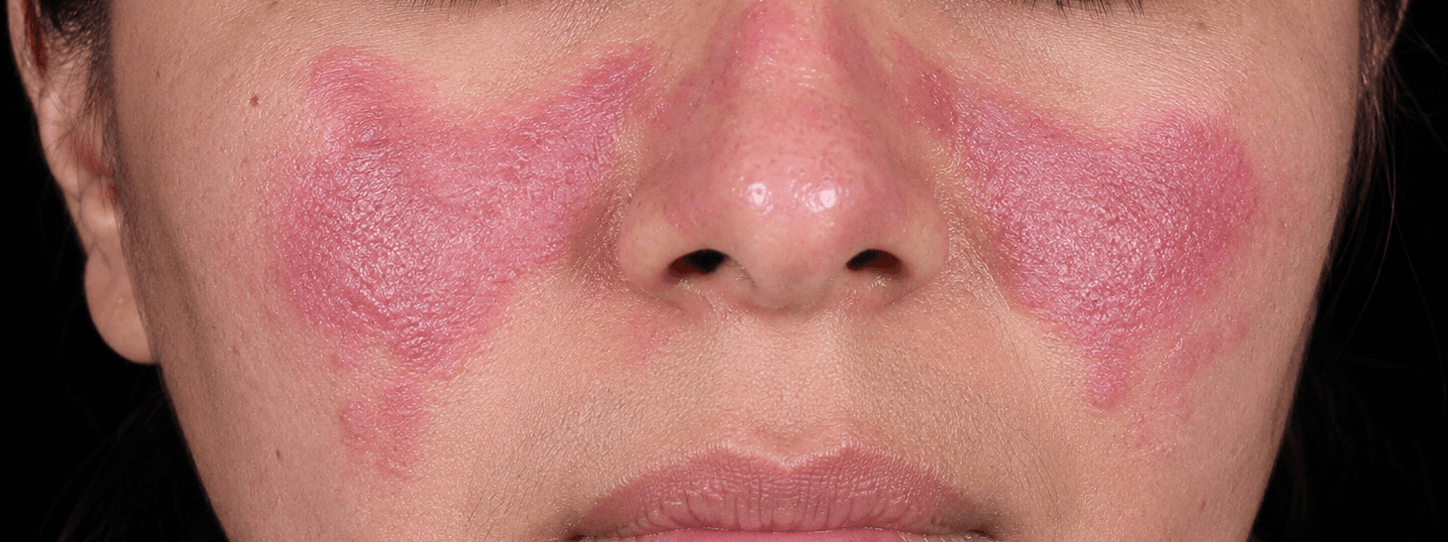
When Lupus Shows Up on the Skin
Cutaneous lupus may announce itself visibly but understanding what the disease is doing and may leave behind requires looking well beyond the lesion.
By Dermsquared Editorial Team | August 14, 2026
Cutaneous lupus is easy to see and surprisingly easy to underestimate.
That sounds contradictory until you sit with it. A plaque on the cheek, patch of dyspigmentation, or scalp lesion with early hair loss are visible findings. But visibility can create its own kind of shorthand. We see what is active now. Patients live with the before, exist between visits, and manage the everyday realities that disease may leave behind.
It’s an important distinction in cutaneous lupus erythematosus (CLE), where inflammation and damage are related but not interchangeable. CLE can present with pain, itch, photosensitivity, dyspigmentation, scarring, and alopecia, and some of those changes may be irreversible. It may occur with or without systemic lupus erythematosus. The dermatologic examination is therefore only part of the story, even when the skin is where the disease first declares itself.
For clinicians, there’s a familiar temptation to let morphology lead the whole conversation. Morphology is essential, of course. But CLE asks more of us. A relatively limited area of involvement can carry significant consequences if the scalp is affected. A rather uneventful examination may conceal flares that occurred weeks earlier. Pigmentary change may persist after inflammatory activity has subsided. And a patient who appears “better” may still be developing new lesions.
What Are We Calling Control?
The question, then, is not simply whether a lesion has improved. It’s whether the disease is being controlled in a way that protects what can still be protected.
That standard requires us to think in two time frames at once: what’s active today and what’s accumulating over time. It also means taking seriously the burden that doesn’t fit cleanly into a lesion count. Scarring, hair loss, visible pigmentary change, treatment burden, and the vigilance required around photosensitivity all shape how a patient experiences the disease. CLE has been associated with substantial effects on quality of life, including depression, anxiety, and fatigue.
And yet the treatment landscape has remained limited. Topical glucocorticoids and antimalarial medications remain first-line therapies, with immunosuppressive agents commonly used when response is inadequate; long-term oral glucocorticoid use is constrained by toxicity. For a disease capable of leaving permanent damage, that therapeutic history has inevitably shaped expectations. Sometimes “better” has had to do a lot of work.
Questions Continue to Shift and Expand
That may be beginning to change, or at least the questions are changing. Interest in more targeted approaches has grown alongside a better understanding of CLE biology, including the role of plasmacytoid dendritic cells and type I interferon signaling.
Litifilimab, an investigational monoclonal antibody targeting BDCA2, showed a significant effect on the primary disease-activity measure in the phase 2 LILAC trial, although most secondary endpoints did not support the primary analysis. In January 2026, the FDA granted litifilimab Breakthrough Therapy Designation for CLE; the therapy remains investigational, and its safety and effectiveness have not been established.
The significance of that moment is larger than any single drug. CLE is being treated as a disease worthy of more precise study, specific therapeutic targets, and clearer definitions of success.
It brings us back to the skin with a much wider lens. What are we trying to prevent? What deserves urgency? What does meaningful control look like when inflammation can recede but damage remains? And how should dermatology think about its role when the disease may extend beyond the skin?
Those are the questions that shape this Experience. They begin with recognition and extend both inward and outward.
.
References
Werth VP, Furie RA, Romero-Diaz J, et al. Trial of anti-BDCA2 antibody litifilimab for cutaneous lupus erythematosus. N Engl J Med. 2022;387(4):321-331. doi:10.1056/NEJMoa2118024.
Biogen. Biogen’s litifilimab receives FDA Breakthrough Therapy Designation for cutaneous lupus erythematosus, a disease with no targeted treatment options. January 28, 2026.