How to Administer the PEST Exam
About this video
Download the Psoriasis Epidemiology Screening Tool (PEST) to use in your practice:
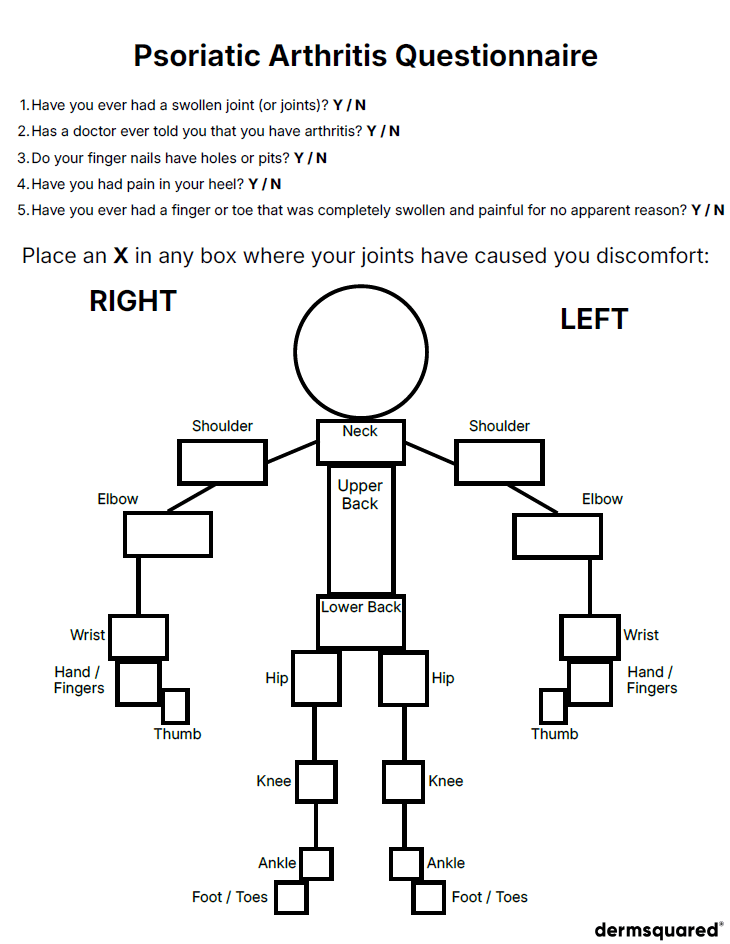
A Practical Screening Tool for Psoriatic Arthritis
Psoriatic arthritis is common, disabling, and still widely underdiagnosed. For patients with psoriasis, missing it can mean irreversible joint damage and loss of function. For PAs and NPs, it represents both a challenge and a unique opportunity.
In this video, Henry Yu, PA-C walks through how he uses the Psoriasis Epidemiology Screening Tool (PEST) as part of routine psoriasis care. Not as a rheumatology workup, but as a focused, efficient screening approach that fits seamlessly into busy days in the clinic.
Simple by design, the PEST exam is a brief five-question questionnaire paired with a targeted physical exam. But when used intentionally, and documented clearly, it becomes a powerful bridge from observation to strategic action.
(Henry Yu likes to use the Group for Research and Assessment of Psoriasis and Psoriatic Arthritis (GRAPPA) app to administer the PEST exam)
Why the PEST Exam Matters
As Yu explains, managing psoriasis without understanding a patient’s PsA status is incomplete care. Psoriatic arthritis can be present regardless of skin severity, and many patients see their dermatology provider more consistently than any other clinician.
Used correctly, the PEST exam helps clinicians:
- Identify patients at higher risk for PsA earlier
- Distinguish inflammatory joint symptoms from common misdiagnoses like plantar fasciitis
- Prompt timely referral or treatment escalation
- Initiate therapies that protect both skin and joints before permanent damage occurs
What the Exam Includes
- Five yes/no questions that address joint swelling, arthritis history, nail changes, heel pain, and dactylitis. A score of three or more signals the need to move forward with further evaluation.
- A focused, systematic physical assessment of:
- MCP, PIP, and DIP joints
- Fingernails (pitting, onycholysis)
- Toes and signs of dactylitis
- Achilles insertion points and plantar fascia
He emphasizes specific documentation not just for accuracy, but because clear documentation forces a treatment decision and supports a shift toward dual-action systemic therapy when indicated.
The full PEST exam takes less than five minutes. But, as Yu notes, it can change the entire trajectory of a patient’s life, allowing dermatology clinicians to intercept psoriatic arthritis years earlier than might otherwise occur.
Editorial note: A substantial proportion of patients with psoriasis have undiagnosed psoriatic arthritis; meta-analysis suggests approximately 15% of psoriasis patients may have unrecognized PsA, with reported prevalence across studies ranging widely and, in some cohorts, approaching 30% or higher, depending on diagnostic criteria and screening methods.¹,²
- Villani AP, Rouzaud M, Sevrain M, et al. Prevalence of undiagnosed psoriatic arthritis among psoriasis patients: a systematic review and meta-analysis. J Am Acad Dermatol. 2015;73(2):242-248.
- Alinaghi F, Calov M, Kristensen LE, et al. Prevalence of psoriatic arthritis in patients with psoriasis: a systematic review and meta-analysis of observational and clinical studies. J Am Acad Dermatol. 2019;80(1):251-265.e19.