Lifelong Atopic Dermatitis with Idiopathic Sudomotor Failure: Response to Lebrikizumab After Dupilumab Failure
Dr Jenny Murase presents a case of severe, dupilumab-refractory atopic dermatitis with idiopathic sudomotor failure successfully managed with lebrikizumab.
By Jenny Murase, MD
Case presentation and medical history summary
An 18-year-old male of Filipino heritage presented with lifelong, chronic, recalcitrant atopic dermatitis (AD) characterized by severe pruritus (Itch Numeric Rating Scale 10).
He had used multiple topical therapies, including clobetasol solution, desoximetasone ointment, triamcinolone 0.1% ointment, tacrolimus ointment, tapinarof (Vtama) cream, roflumilast (Zoryve) cream, ketoconazole shampoo, and mupirocin ointment, along with loratadine and hydroxyzine for symptomatic relief of pruritus.
His medical history was notable for an elevated body mass index (pediatric 85th–94th percentile). He did not have asthma.
In addition to chronic pruritus, the patient described episodic, intense, generalized pain triggered by physical exertion (eg, walking uphill), heat exposure, or emotional stress. These episodes lasted approximately 5–10 minutes and were described as sensations of “sharp needles” or “electric shocks,” sparing the palms and soles. He reported lifelong hypohidrosis and noted that these episodes occurred when his body temperature reached a threshold level, supporting a clinical diagnosis of idiopathic sudomotor failure.
Physical exam and lab results
A biopsy of the left upper arm demonstrated subacute spongiotic dermatitis with eosinophils, consistent with atopic dermatitis.
A bacterial culture (12/23/21) was positive for Staphylococcus aureus, which was treated with cephalexin 500 mg twice daily for 14 days.
Eradication of S. aureus from both the patient and his environment was emphasized as an important part of management, given that bacterial colonization and patch testing for contact allergens are 2 key exogenous factors that can significantly aggravate underlying AD.
Diagnostic review
The diagnosis of AD in this patient was clinically evident, based on his lifelong history of relapsing, pruritic, eczematous eruptions with characteristic distribution and chronicity. Because the dermatitis was diffuse and not accentuated on the face, hands, or genitals, concomitant allergic contact dermatitis was thought to be unlikely and patch testing was not pursued.
Idiopathic sudomotor failure can be associated with which underlying dermatologic condition, making it important to assess both pain and itch in response to exercise or heat?
Lebrikizumab (Ebglyss) has data to support its use in patients in all the following clinical contexts EXCEPT:
Before & After Photos
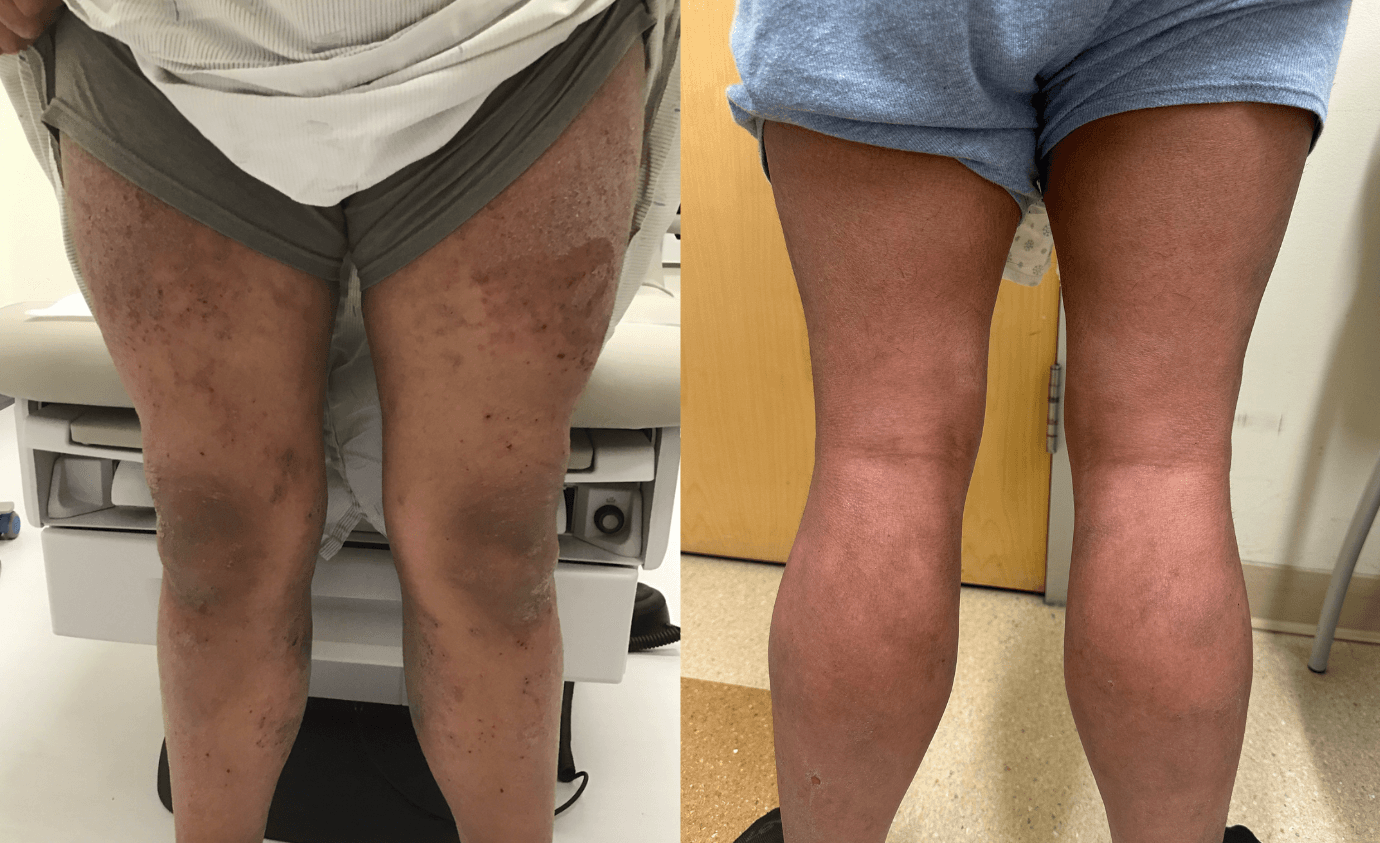
Before: Baseline clinical photographs (December 2021) demonstrate diffuse atopic dermatitis involving the back and bilateral upper and lower extremities. The affected areas appear as erythematous patches with excoriations and superficial erosions, consistent with chronic scratching and pruritic. The overall presentation is consistent with moderate-to-severe, widespread atopic dermatitis prior to initiation of systemic therapy with dupilumab.
After dupilumab initiation: Follow-up photographs (September 2024) demonstrate partial improvement in the patient’s AD after more than one year of dupilumab therapy (300 mg every other week). At the time of imaging, weekly dosing had been initiated due to persistent symptoms. The skin of the back, arms, and legs shows a partial improvement in overall presentation compared with baseline, but the patient continued to report severe pruritus, prompting escalation of therapy.
After lebrikizumab initiation: Clinical photographs obtained in October 2025, approximately 3 months after initiation of lebrikizumab, demonstrate marked improvement in patient’s atopic dermatitis, with an estimated 80% reduction in disease activity. The overall appearance reflect substantial clearance of inflammation and restoration of skin integrity, consistent with a robust response to IL-13 inhibition.
Treatment discussion and outcome
The patient initiated dupilumab (Dupixent) on August 4, 2022 at 300 mg every other week, resulting in partial improvement but persistent significant pruritus. In September 2024, dosing was increased to 300 mg weekly. Even after 10 months on weekly dosing, he continued to require daily desoximetasone ointment (diluted with moisturizer) applied after each shower to maintain control.
To avoid unnecessary broad immunosuppression and to focus on selective inhibition of Th2-mediated inflammation, the patient was transitioned to lebrikizumab (Ebglyss) in July 2025. The first loading dose (500 mg) was administered on July 8, 2025, following the recommended regimen: 500 mg at week 0 and week 2, then 250 mg every 2 weeks for months 2–4, with plans to continue 250 mg monthly thereafter.
After 3 months, the patient demonstrated >80% improvement in disease activity and pruritus.
The patient’s history of idiopathic sudomotor failure is clinically significant. Patients with AD often report being “allergic to their own sweat” or experiencing worsening eczema in flexural areas with perspiration; however, this patient described sudden, debilitating pain triggered by heat or exertion, a symptom profile distinct from typical sweat-related irritation.1 Eliciting detailed histories regarding pain onset, duration, and triggers can uncover such atypical presentations, which may otherwise be missed during standard AD evaluations.
Therapeutic rationale for lebrikizumab
The decision to transition to lebrikizumab was supported by its strong IL-13 binding affinity (Kd = 6.3 pM vs 904 pM for tralokinumab).2 This high-affinity binding may underlie its robust monotherapy durability, as demonstrated in long-term studies:
- In the ADvocate studies, no adjunctive topical therapy was required in 88% to 90% of patients at 1 year (Week 52) on Q4W and Q2W treatment arms, respectively. Through 3 years in the long-term extension ADjoin study, no adjunctive topical therapy was required in 86% to 95% of patients, depending on treatment arm.3,4
- Notably, lebrikizumab has been shown to maintain extended remission periods even after discontinuation. When comparing patients who continued treatment for 12 months versus those who stopped for 8 months after 4 months of treatment, efficacy remained high—EASI-75: 79% vs. 61%; EASI-90: 78% vs. 55%; ≥4-point NRS improvement: 80% vs. 65%.
These data suggest that lebrikizumab may induce long-lasting remission of both rash and pruritus,5 supporting its use in patients inadequately controlled on dupilumab despite optimized dosing and adherence.
An additional consideration is that lebrikizumab has been shown to reduce head and neck erythema in patients with AD.6 Thus, it should be considered in patients with residual head and neck involvement on dupilumab, once expanded patch testing has excluded allergic contact dermatitis as a confounding factor.
References
- Young AT, Yedidi RS, Raffi J, et al. Idiopathic pure sudomotor failure: A review and two cases. Int J Womens Dermatol. 2020;7(3):276-279. doi:10.1016/j.ijwd.2020.12.011
- Okragly AJ, Ryuzoji A, Wulur I, et al. Binding, Neutralization and Internalization of the Interleukin-13 Antibody, Lebrikizumab. Dermatol Ther (Heidelb). 2023;13(7):1535-1547. doi:10.1007/s13555-023-00947-7
- Del Rosso J, Nosbaum A, Golant A, et al. The TCS/TCI-free rate remains high and stable while on lebrikizumab for treatment of moderate-to-severe atopic dermatitis over 1 year. Br J Dermatol. 2024;191(Supplement_2):725. doi:10.1093/bjd/ljae266.098
- Simpson E, Biedermann T, Kircik L, et al. Raising the bar of efficacy in atopic dermatitis: lebrikizumab maintains depth of response over 3 years in week 16 responders. J Am Acad Dermatol. 2025;93(3, Supplement):63541. doi:10.1016/j.jaad.2025.05.1112
- Blauvelt A, Thyssen JP, Guttman-Yassky E, et al. Efficacy and safety of lebrikizumab in moderate-to-severe atopic dermatitis: 52-week results of two randomized double-blinded placebo-controlled phase III trials. Br J Dermatol. 2023;188(6):740-748. doi:10.1093/bjd/ljad022
- Murase JE, Eyerich K, Chovatiya R, et al. Lebrikizumab improves head/neck/face dermatitis and erythema and does not increase treatment-emergent adverse events of head/neck/face erythema in patients with moderate-to-severe atopic dermatitis. J Dermatolog Treat. 2025;36(1):2492188. doi:10.1080/09546634.2025.2492188